Windows Server Update Services (WSUS) is one of the most widely deployed mechanisms for distributing Microsoft patches across enterprise environments. Many Linux or cloud-focused administrators still rely on WSUS indirectly because mixed estates require a consistent Windows update workflow.
A newly disclosed vulnerability, CVE-2025-59287, highlights just how critical this update pipeline has become—and how dangerous it can be when its trust boundaries fail.
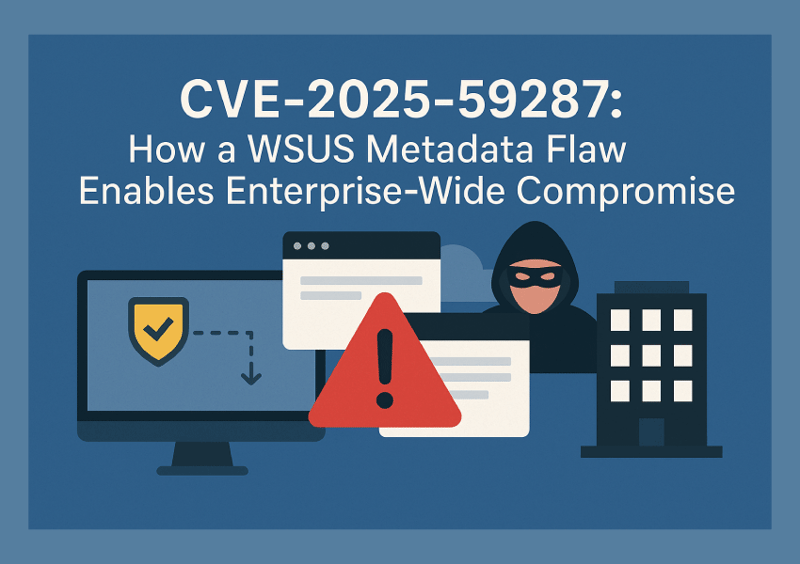
What CVE-2025-59287 Is and Why It Matters
CVE-2025-59287 exposes a flaw in the WSUS content distribution and approval pipeline, where update metadata is not sufficiently validated.This metadata determines:
- Which binaries clients should download
- Which updates are approved
- The expected content location and version
Because WSUS automatically distributes updates to downstream clients—often without user interaction—a compromise in this path can silently impact every Windows system that trusts the WSUS server.
The vulnerability allows a malicious actor with network presence or limited authenticated access to inject tampered update payloads by manipulating WSUS metadata. Even though Microsoft signs individual patch binaries, the metadata chain WSUS uses to stage and publish updates is not fully protected.
This creates an opening where an attacker can:
- Alter a metadata pointer for an approved update
- Redirect clients to a malicious binary masquerading as a legitimate KB package
- Have endpoints download, trust, and execute the payload automatically
Technical Breakdown of the Exploit Path
The core issue is WSUS’s inadequate signature enforcement during synchronization and approval. Here’s what can go wrong:
- WSUS pulls update metadata from upstream catalog sources.
- That metadata instructs WSUS on which payloads to store and distribute.
- Because the metadata integrity is not fully protected, a local attacker can alter it.
- Clients trust the WSUS-published metadata and fetch whatever payload it references.
- A rogue binary (e.g., modified .msu/.cab installer) gets executed as a trusted update.
Once this trust chain is broken, attackers can:
- Deploy backdoors or RATs under the guise of Windows updates
- Escalate privileges using trusted update mechanisms
- Use WSUS as a pivot to compromise AD-joined Windows clients
- Laterally move across the network without triggering typical detection pathways
How Codenotary Guardian Stops WSUS Metadata and Supply-Chain Attacks
CVE-2025-59287 is a reminder that signed binaries alone are not enough. You also need strong guarantees about the metadata, the distribution path, and the runtime behavior of what actually lands on endpoints.
Codenotary Guardian provides this through a combined approach of software supply-chain integrity and continuous runtime verification.
1. Full Integrity & Provenance Validation for Every Update
Guardian continuously validates the origin and integrity of all software objects—including those flowing through WSUS. It does this by:
- Computing cryptographic fingerprints for every update
- Comparing them against trusted baselines in an immutable trust ledger
- Verifying that metadata, hashes, and package lineage match expected values
2. AI-Driven Runtime Analysis
Guardian’s AI engine monitors update behavior across the environment:
- Detects anomalous WSUS content
- Correlates observed binaries with known patch families
- Identifies suspicious update lineage or unexpected package characteristics
This ensures tampered updates cannot hide inside normal maintenance operations.
3. Automatic Quarantine, Rollback, and Isolation
If a malicious or altered update is detected:
- Endpoints automatically quarantine the affected package
- Modified updates are removed and replaced with verified originals
- WSUS servers exhibiting suspicious publishing behavior are isolated
- Guardian prevents further propagation before broad compromise occurs
This closes the operational gap between detection and response—critical when the update mechanism itself is weaponized.
Why This Matters for Mixed Environments
Linux administrators, security engineers, and Windows admins often share responsibility for patching and update hygiene. CVE-2025-59287 shows that a single vulnerable WSUS instance can:
- Cascade into domain-wide compromise
- Impact Linux servers indirectly through credential theft and lateral movement
- Undermine compliance controls that rely on accurate patch state
When update systems become attack vectors, the entire environment becomes vulnerable.
Conclusion
CVE-2025-59287 highlights the fragility of metadata-driven update pipelines. It is not enough to trust signed binaries; organizations must also validate the entire supply-chain path and runtime behavior of the software being deployed.
By combining cryptographic integrity validation, AI-driven runtime inspection, and automated rollback, Codenotary Guardian provides full-stack protection against WSUS-based supply-chain attacks—ensuring that a single compromise cannot escalate into an enterprise-wide breach.


