 By
By
A recent tutorial, “How to Stop Blindly Trusting Your AI Agents”, highlights a subtle but increasingly important operational problem in enterprise AI deployments: agents often fail silently.
How AI Agents Fail Silently, and Why Enterprises Often Miss It
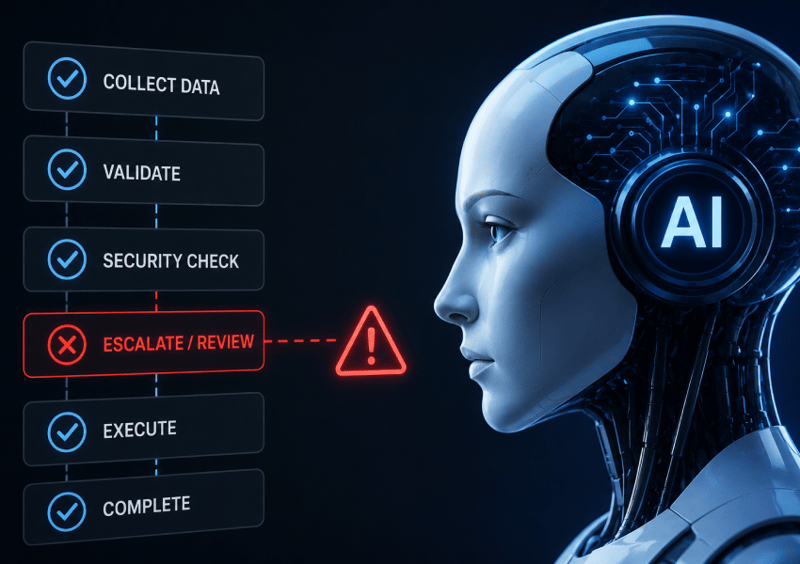
An orchestrator decides not to invoke a specialized sub-agent, a validation step is skipped, or a security check is bypassed—not because of a software bug, but because the model concludes that the step is optional.
This is a much deeper problem than simple hallucinations. It is an observability problem.
Traditional distributed systems were built around deterministic execution. If a microservice fails to call another service, we have logs, traces, metrics, and exceptions. Modern agentic systems, by contrast, are probabilistic orchestration engines. A planner model evaluates context, interprets instructions, decides which tools to invoke, and dynamically rewrites its own execution path. The resulting workflow may differ from one run to the next, even when the input is identical.
That flexibility is precisely what makes AI agents powerful—but it also creates a new attack surface and a new operational blind spot.
The central challenge is that enterprises currently have very limited visibility into decision provenance. Most teams can tell that an agent completed a task, but they cannot easily answer more fundamental questions:
- Which agents participated?
- Which tools were invoked?
- Which planned steps were skipped?
- What data sources were accessed?
- What permissions were exercised?
- Why did the model decide that a shortcut was acceptable?
Agent Observability: The Missing Layer in Enterprise AI Security
Without this level of telemetry, organizations are effectively running autonomous software with only partial runtime visibility.
This becomes particularly dangerous in multi-agent environments. An enterprise may have dozens or hundreds of specialized agents handling code review, document analysis, compliance validation, customer support, infrastructure management, and financial operations. An orchestrator might be designed to delegate security-sensitive work to dedicated expert agents, but unless that delegation is continuously monitored, there is no guarantee it actually happened. As demonstrated in the original tutorial, an apparently successful run may have quietly omitted critical review stages altogether.
The implications extend well beyond software engineering. Imagine a procurement agent that skips a fraud-detection check because it believes a transaction is routine, or an HR workflow that bypasses a mandatory privacy filter before sharing employee records. The resulting output may look perfectly reasonable while violating internal policy or regulatory obligations.
This is why agent observability should be treated much like security observability. We do not trust that every server, container, or API behaves correctly simply because it returned HTTP 200. We instrument it, log it, trace it, and continuously monitor deviations from expected behavior.
The same principle should apply to AI agents.
A mature enterprise architecture for agentic systems should include several technical controls:
- Agent inventory and identity: Every agent should have a unique, verifiable identity rather than operating under generic service credentials.
- Runtime telemetry: Every invocation, delegation, tool call, and external API interaction should be recorded.
- Policy-aware monitoring: Systems should understand not only whether an action occurred, but whether it complied with organizational rules and best practices.
- Behavioral baselining: Changes in invocation patterns or delegation chains should automatically trigger alerts.
- Immutable audit trails: Security teams need cryptographically verifiable evidence of what the agent knew, what it decided, and what actions it ultimately took.
This is where platforms such as Codenotary’s AgentMon move beyond simple logging. The objective is not merely to capture terminal output or API traces, but to reconstruct the complete execution graph of an agentic workflow. By continuously monitoring agent interactions, delegated tasks, prompts, tool usage, and security-relevant events, organizations gain the ability to detect silent failures before they become production incidents.
The evolution of enterprise AI is rapidly shifting from “Can the agent perform this task?” to a more important question: “Can we prove exactly how the task was performed?”
The Future of Enterprise AI Depends on Visibility, Accountability, and Governance
In the coming years, the organizations that successfully deploy AI at scale will not necessarily be those with the most capable models. They will be the ones that build the strongest foundations for visibility, accountability, and runtime governance. Autonomous systems are only as trustworthy as our ability to observe them—and in an agentic world, blind trust is no longer a viable security model.


