Something fundamental has shifted in modern computing:
Natural language is no longer just an interface—it is becoming part of the execution model.
TL;DR
Natural language has moved from being a user interface to becoming part of the execution pipeline of modern AI systems. Large language models are excellent at reasoning, abstraction, and intent formation—but they are inherently probabilistic and ambiguous. Deterministic action still requires formal structure.
The solution is a layered architecture:
- Language for intent, planning, and reasoning
- Logic (predicate logic + ontologies) to ground meaning, enforce constraints, and make intent verifiable
- Execution through typed, deterministic systems like APIs, databases, and workflows
From Interface to Executable Substrate
Historically, language existed outside the machine. Humans expressed intent in prose, then translated that intent into code, schemas, and configuration. Natural language was lossy, informal, and deliberately excluded from the trusted core of systems.
Large language models have inverted this relationship.
Today, text is used to:
- Define agent behavior
- Select and compose APIs
- Control tool invocation
- Evolve reasoning strategies
- Encode policies, constraints, and goals
In several recent benchmarks and production systems, English instructions now outperform handwritten code for tasks involving abstraction, generalization, and compositional reasoning. This is not because language is “better” than code—but because it occupies a different point in the expressivity–precision tradeoff.
Language has entered the stack.
Expressivity vs. Determinism
Natural language is maximally expressive but minimally constrained.
From a formal perspective, this gives it three critical advantages:
- High semantic bandwidth
A single sentence can encode intent, constraints, preferences, exceptions, and priorities simultaneously. - Implicit structure
Meaning emerges from context, not syntax alone. Humans exploit this effortlessly; LLMs approximate it statistically. - Compositional flexibility
Concepts can be recombined without predefined schemas.
However, this expressivity comes at a well-known cost:
- No fixed semantics
- No guaranteed referential integrity
- No deterministic execution
- No proof of correctness
This is why we do not execute natural language directly.
Formal systems—programming languages, type systems, mathematical logic—exist specifically to eliminate ambiguity. They narrow the space of valid expressions so that interpretation becomes mechanical.
The core problem in modern AI systems is therefore not “how do we make language precise?”
It is how do we connect imprecise language to precise execution without collapsing either side.
Predicate Logic as the Semantic Boundary Layer
The correct abstraction boundary is first-order predicate logic (FOL).
FOL is expressive enough to model:
- Objects and classes
- Properties and attributes
- Relations between entities
- Quantification (∀, ∃)
- Constraints and invariants
- Well-defined semantics
- Decidable fragments
- A direct mapping to databases, rule engines, and solvers
Crucially, FOL mirrors the grammatical structure of natural language:
| Natural Language | Predicate Logic |
|
“Servers that run Linux” |
Server(x) ∧ Runs(x, Linux) |
|
“Every VM must have a backup” |
∀x (VM(x) → HasBackup(x)) |
|
“Find vulnerable containers” |
∃x (Container(x) ∧ Vulnerable(x)) |
This is not accidental. Predicate logic was explicitly designed as a formalization of reasoning expressed in language.
Ontologies: Freezing Meaning Without Freezing Language
When predicate logic is specialized to a domain, it becomes an ontology.
An ontology provides:
- A controlled vocabulary
- Explicit entity types
- Typed relations
- Constraints and axioms
Example (simplified):
VM(x)
Host(y)
RunsOn(x, y)
HasCVE(x, cve_id)
Severity(cve_id, High)
This structure does not replace natural language. Instead, it provides a semantic anchor.
An LLM can:
- Parse free-form user intent
- Map phrases to ontology entities
- Generate candidate predicates
- Propose queries, rules, or actions
But execution happens only once the intent is grounded in the ontology.
This separation is critical:
- Language remains flexible and human-centric
- Logic remains inspectable and enforceable
- Failures are debuggable at the semantic layer
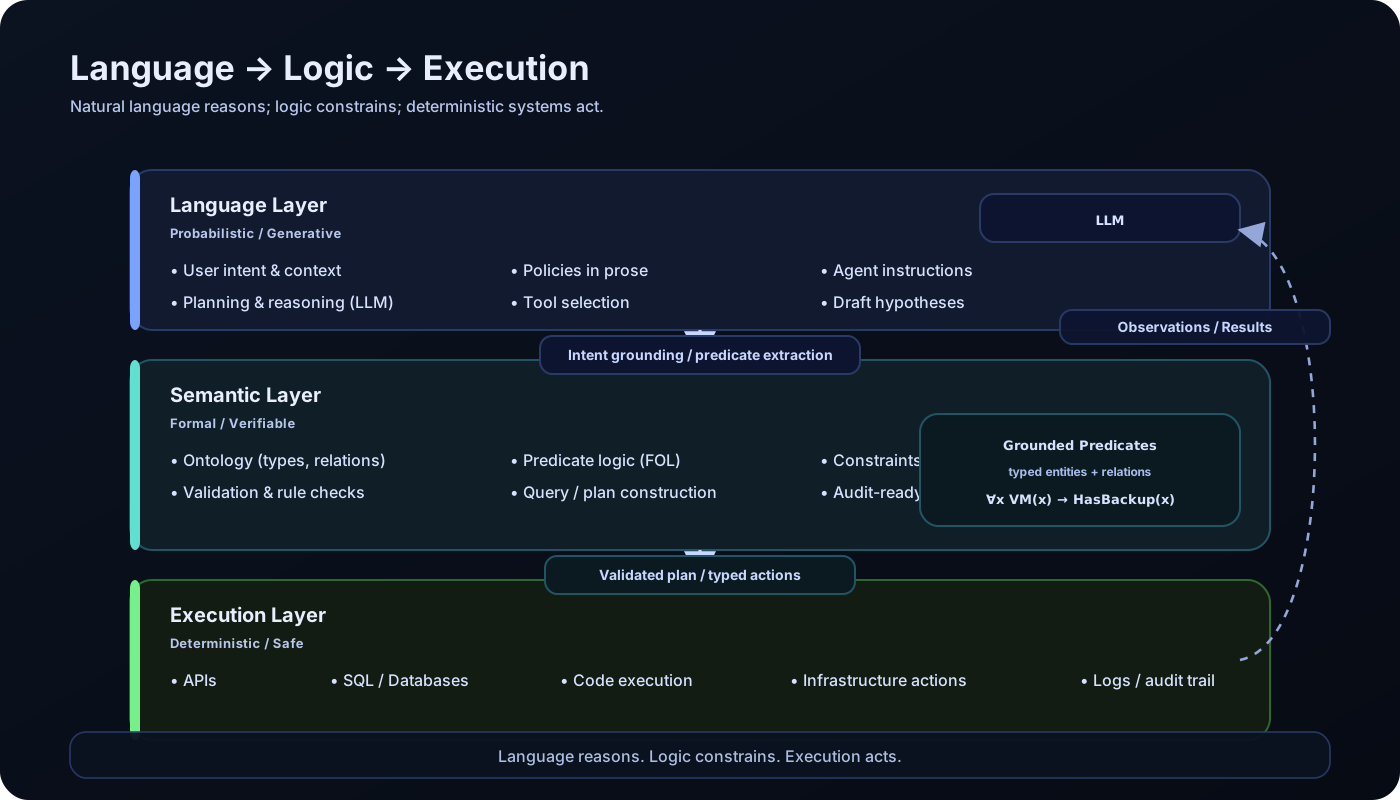
Architecture: Language → Logic → Execution
A robust AI system follows a three-stage pipeline:
1. Language Layer (Probabilistic)
- User intent
- Policies expressed in prose
- Agent instructions
- Contextual reasoning
Handled by:
- LLMs
- Prompt templates
- Conversation state
2. Semantic Layer (Formal)
- Predicate extraction
- Ontology grounding
- Constraint validation
- Rule composition
Handled by:
- Ontologies (OWL / RDF / custom schemas)
- Rule engines
- Query planners
- Type systems
3. Execution Layer (Deterministic)
- API calls
- Database queries
- Code execution
- Infrastructure actions
Handled by:
- Tooling
- APIs
- Workflow engines
- Traditional software
Language never directly executes.
Logic mediates.
Why Prompt Engineering Alone Does Not Scale
Pure prompt engineering attempts to enforce structure through statistical pressure:
- “Always respond in JSON”
- “Do not hallucinate”
- “Follow these rules exactly”
This works locally but fails globally:
- Prompts are not composable
- Constraints are not verifiable
- Errors are silent
- Semantics drift over time
From a systems perspective, this is brittle.
Neural-symbolic approaches are not a workaround—they are the correct architectural resolution. They align with how computation has always scaled: by separating meaning from execution.
The Direction of Travel
We are already seeing convergence:
- Text-defined agent capabilities
- Tool schemas acting as ontologies
- Execution constrained by typed interfaces
- Policies expressed as declarative rules
- LLMs acting as planners, not executors
This is not a temporary pattern. It is the natural equilibrium between human expressivity and machine reliability.
The future of AI systems is not “LLMs everywhere.”
It is LLMs at the boundary, reasoning in language, grounded in logic, driving deterministic systems.
Language becomes powerful not when it replaces code—but when it is finally given a formal place next to it.


