 By
By
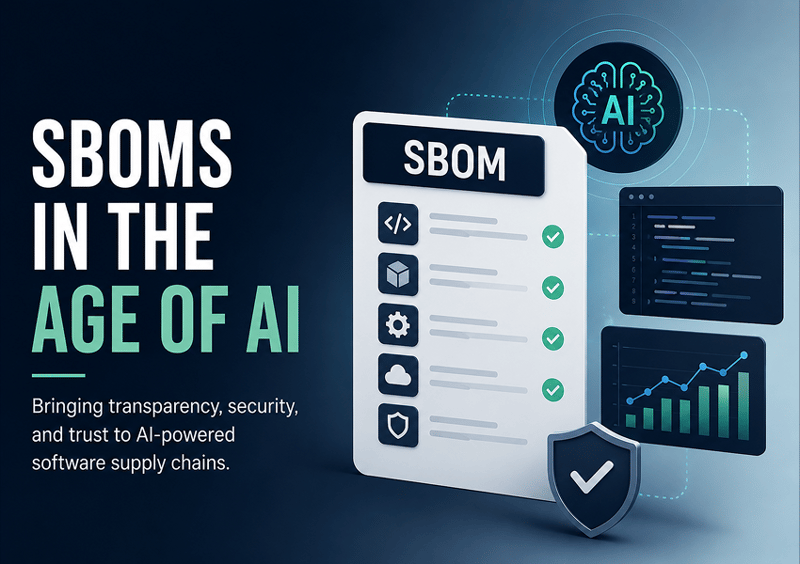
The Software Bill of Materials (SBOM) has become one of the most practical advances in software security and transparency in the last decade. SBOMs help organizations understand what they ship — providing inventories of open source libraries, third-party components, and build dependencies. That visibility provides a better understanding of how the application is built, strengthens risk management, accelerates vulnerability response, and supports procurement and compliance.
But, the software world that SBOMs were designed for is rapidly disappearing as AI applications become more pervasive.
Classical SBOM solutions were designed to inventory code artifacts: source code packages, libraries, transitive dependencies. That remains necessary — but in AI-native software, it is no longer sufficient. The behavior of AI applications is shaped not just by code, but by datasets, models, inference endpoints, integrations, and operational controls. Traditional SBOMs overlook those entirely.
Let’s examine these in more detail.
The AI Supply Chain Is Not Static
We need to extend SBOMs from a static list of code dependencies into a living, behavioral inventory of the artifacts that shape AI applications in production.
Capturing What Drives AI: Data Provenance
With AI, datasets are foundational. In AI-native systems, data is as critical as code — and should be treated that way. Yet traditional SBOM tools typically ignore data entirely. That gap is now a major governance and security blind spot.
Where did a dataset come from? Was it licensed? Was it approved? Does it contain regulated or personal information? Can it be used commercially? If those questions cannot be answered quickly, AI systems will continually introduce compliance risk — even when the underlying code is “clean.”
It’s essential to document dataset sources, classifications, licensing terms, and approval status. These can be treated as SBOM artifacts for stronger governance, improved licensing and policy compliance to help establish audit-ready provenance.
Full Model Lineage and Training Transparency
AI models do not exist in isolation. They are trained, fine-tuned, versioned, and updated.
It’s important to capture model lineage in depth, including base model origins, training and fine-tuning details, version identifiers, and update history. This enables teams to trace outputs back to specific model versions and training inputs — an essential requirement for debugging, risk analysis, and regulatory accountability.
As AI regulation and enterprise governance mature, “Which model generated this result, and why?” becomes a foundational question. Model lineage should not be tribal knowledge. It should be structured supply chain data.
Operational Visibility: Inference, Integrations, and Exposure
It’s also necessary to document inference endpoints alongside access policies to understand where AI capabilities are reachable and who can interact with them. It also captures monitoring and observability hooks as well as downstream systems that consume AI output. That operational context is critical for incident response, blast-radius assessment, and runtime governance — especially as AI systems become more deeply embedded across enterprise workflows.
Ownership and Accountability Across AI Components
Another common AI challenge isn’t technical — it’s organizational. When something goes wrong, teams often struggle with basic questions: Who approved this dataset? Who owns the model? Who is accountable for the integration?
Lack of ownership clarity slows incident response and turns audits into archaeology.
For that reason, it’s critical to have ownership and approval metadata across AI components, enforcing accountability and simplifying governance. That dramatically reduces time-to-resolution during security incidents and compliance reviews, while enabling stronger policy enforcement across the AI lifecycle.
The Bottom Line
SBOMs remain essential. But, we have to recognize that SBOMs built for static software are not sufficient for AI-native systems.In the age of AI-native software, dependency tracking is only the beginning.
Modern AI software is built, deployed, and governed through assets and processes beyond code: data provenance, model lineage, inference exposure, runtime integration, and accountability.
To do just that our company has made available a free online service, SBOM.sh, that enables developers, DevOps teams, and security organizations to upload, analyze, and share SBOMs, as well as their AI software supply chain performing those functions outlined here.


