
Linux has never been limited to large enterprises. It runs home servers, development machines, web servers, small business infrastructure, laboratories, schools, nonprofits and thousands of organizations where there may be no dedicated security team at all.
Yet much of the modern Linux security industry is built as though every Linux system belongs to a Fortune 500 company.
That is why Codenotary's new Linux offering at apps.codenotary.com/linux is significant. It gives Linux users access to serious security capabilities without first requiring an enterprise evaluation, procurement process or security budget. The offering is free for up to 25 Linux machines, making it practical for home users, small companies and organizations that would otherwise simply go without this type of protection.
And this isn't just another vulnerability scanner.
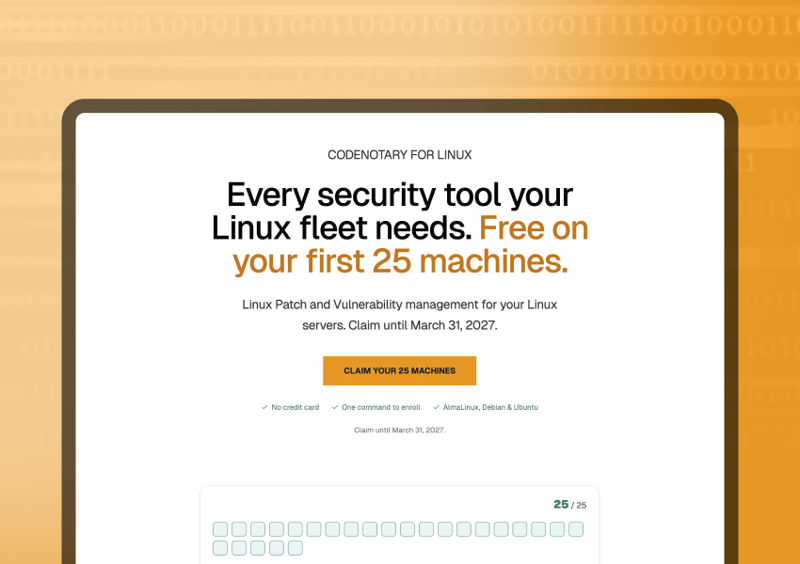
Codenotary Trust looks across the Linux system for vulnerabilities, missing patches, configuration weaknesses and CIS benchmark failures. It can identify which vulnerabilities have known public exploits, show the package version that fixes them, and help remediate security problems rather than simply producing another long list for somebody to investigate. Codenotary also provides AI-assisted remediation and warns about changes that could potentially break a system before they are applied.
That distinction matters enormously outside the enterprise.
A large corporation can employ Linux administrators, vulnerability management teams and security analysts. Someone running five servers for a small company cannot. Neither can the person running Linux systems at home, the two-person software startup, the local hosting provider, a research group or a nonprofit with a few dozen machines.
Their systems face many of the same vulnerabilities. What they lack are the people and time required to continuously evaluate them.
Security products have traditionally addressed that problem by selling more sophisticated tools to organizations capable of operating them. AI allows us to approach the problem differently: make the software do more of the security work itself.
Installation is deliberately simple, using a single CLI rather than kernel modules or additional appliances, and the platform can continuously show the state of Linux machines from a central interface.
Linux helped democratize computing infrastructure. Security for Linux should follow the same principle.
Making sophisticated Linux security accessible to people who don't have an enterprise security team may ultimately be every bit as important as making the technology more sophisticated. The machines belonging to smaller organizations still need protection. Now there is far less reason for them to go without it.


