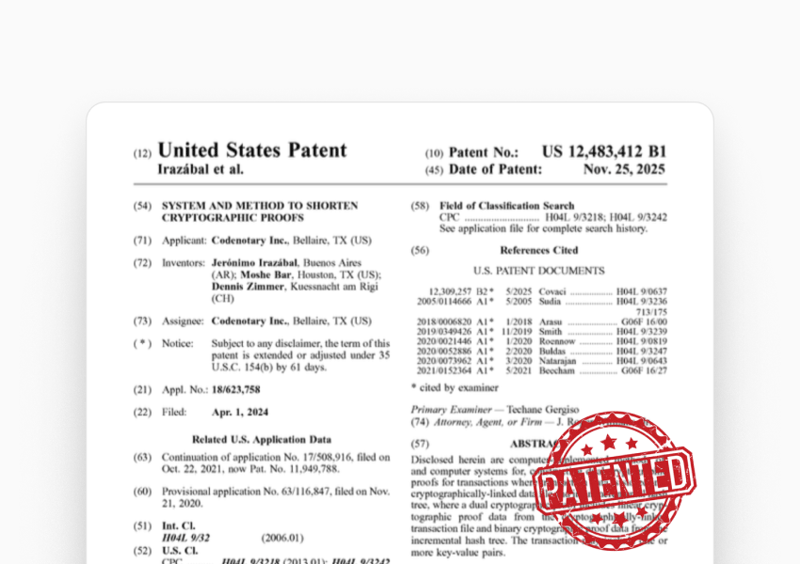
We're excited to announce that Codenotary has been granted U.S. Patent No. 12,483,412 for our innovative "System and Method to Shorten Cryptographic Proofs." This patent represents a significant advancement in how data integrity can be verified at large scale—and it's at the heart of what makes our Trustcenter software supply chain protection platform so powerful.
What Problem Does This Solve?
Modern enterprises need to verify that their software, build artifacts, and sensitive data haven't been tampered with.
This indispensable certainty is dynamically provisioned through the strategic deployment of cryptographic proof mechanisms, which fundamentally generate irrefutable, mathematically-validated evidence that substantiates the immutable and untampered status of data from its initial point of inscription.
However, traditional approaches face a fundamental challenge: as databases grow to millions or billions of records, generating and verifying these proofs becomes increasingly resource-intensive. You're forced to choose between fast verification with large proof sizes, or smaller proofs that take longer to compute.
Our Innovation: The Best of Both Worlds
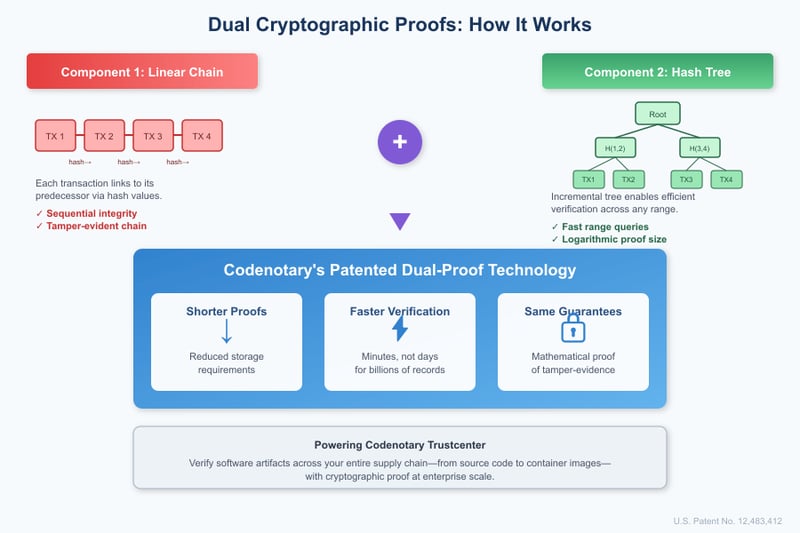
Our patented technology introduces what we call "dual cryptographic proofs"—a novel approach that combines two powerful techniques. The first component uses linear cryptographic linking, where each transaction is chained to its predecessor through hash values, creating an unbreakable sequence. The second component leverages an incremental hash tree structure that enables efficient verification across any range of transactions.
By intelligently combining these approaches, our system generates proofs that are significantly shorter than traditional methods while maintaining the same mathematical guarantees of tamper-evidence. This means faster verification, reduced storage requirements, and better performance at enterprise scale.
Why This Matters for Codenotary Trustcenter
Trustcenter protects your software supply chain by ensuring that every component—from source code to container images and their attestations—are tracked immutably from origin to deployment. Built on immudb, our high-performance immutable database, Trustcenter leverages this patented technology to deliver cryptographic verification of attestations that scales with your organization, and most importantly gives you, your auditors and ultimately your customers peace of mind when it comes to the security of your software.
When a security team needs to verify that a software artifact hasn't been compromised, they need answers in minutes, not days or weeks. Our dual-proof technology makes this possible even when dealing with billions of recorded transactions across your entire software supply chain. Some organizations using Trustcenter have many billions of artifacts throughout their software development process, and all those need attestations stored safely.
This patent validates the technical innovation that sets Codenotary apart in the software supply chain security market. While others rely on conventional database approaches that can be modified or manipulated, our mathematically-proven immutability guarantees provide the foundation for true zero-trust security.
This patent is just the latest milestone in our mission to make software supply chain security verifiable, not just promised. As attacks on software supply chains continue to grow in sophistication, organizations need solutions backed by proven cryptographic guarantees—not just best practices.
We're proud of this innovation, developed by our expert engineers. It reinforces our commitment to delivering technology that enterprises can trust with their most critical security requirements.
In case you want to read the full patent, 12483412 search here for : https://ppubs.uspto.gov/pubwebapp/static/pages/ppubsbasic.html


