$ protect --distro almalinux --machines 25 --free
Start now
TRUST
Your Linux fleet, patched, hardened and audit-ready.
Every unpatched CVE, failed CIS control and risky config across your Linux estate — found, ranked, fixed. One command per host.
No credit card. No agent sprawl. No kernel modules.
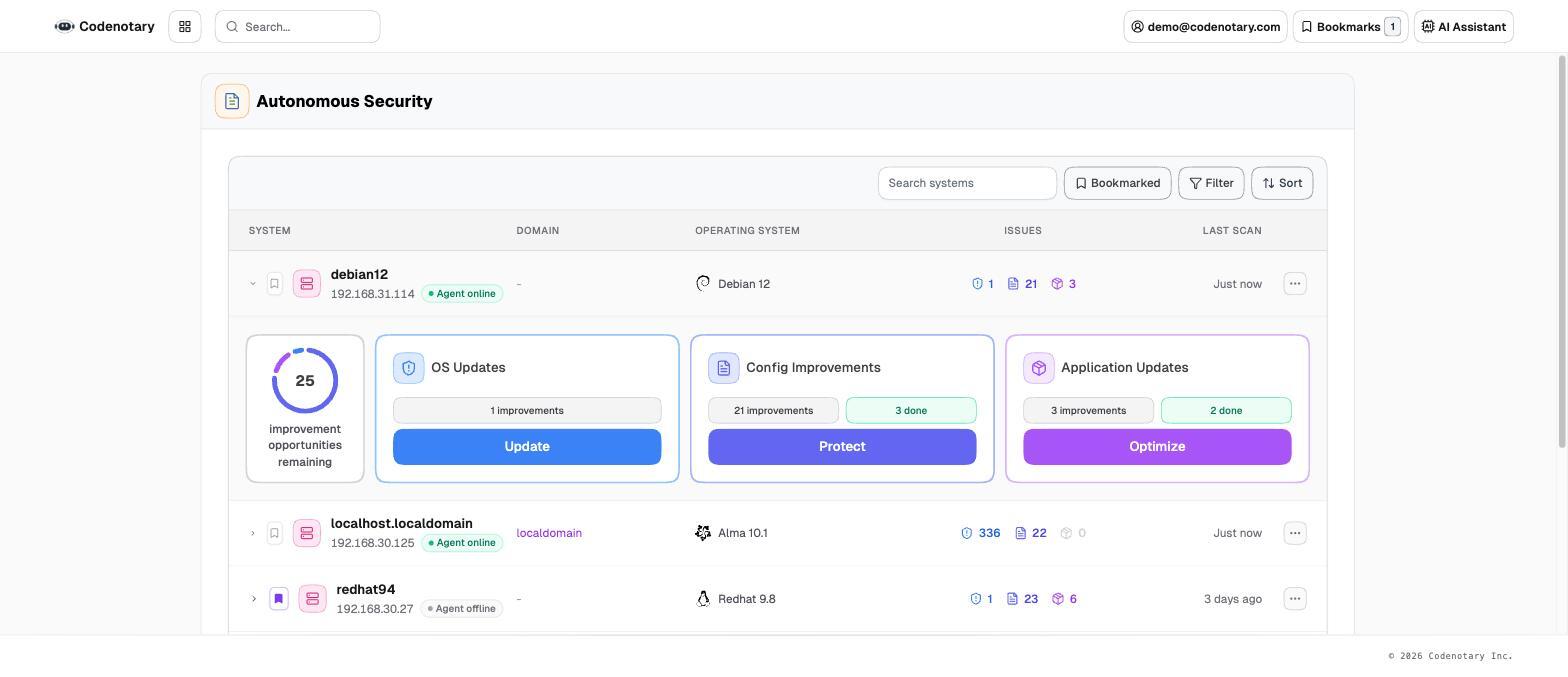
Autonomous Security — live fleet view.
Patch Tuesday never ends.
One Debian box is carrying 1,748 open CVEs — 125 critical. The RHEL server hasn't checked in for three days. And the auditor wants a CIS report by Friday.
None of it is difficult. It's just endless. Trust reads, ranks and fixes — and pulls you in only when a change could break something.
Everything you need to run AI agents safely
Patching, hardening, audits, 2 a.m. pages. Five jobs, one place.
SEE YOUR WHOLE FLEET
What you're running, and what state it's in.
Every host, one list
Distro, agent status, open issues. Debian, Ubuntu, RHEL and AlmaLinux in one view.
Live activity log
Scans, fixes and check-ins, as they happen.
PATCH WHAT MATTERS
Fix the handful that are exploitable, not all 1,748.
Exploit-aware ranking
Public exploit code and offensive tooling, separated from noise.
The exact fixed version
The package and version that closes it, named.
HARDEN WITHOUT BREAKING PROD
Hardening you can apply on a Tuesday afternoon.
Full CIS benchmark
365 controls per host, Critical to Compliant.
Fix with AI
One click turns a failed control into a verified change.
Breaking-risk warnings
Lock-you-out controls flagged before you run them.
AUDIT-READY ON DEMAND
Walk into the audit with the evidence ready.
Reports in one click
CIS, PCI and vulnerability reports. PDF, CSV, XLS.
AI-written summaries
Drafted from your scan data, not a template.
Evidence that holds up
Tamper-evident history. "When was this fixed?" always answerable.
ASK IN PLAIN ENGLISH
No Linux security specialist on staff required.
Built-in AI assistant
"Which should I fix first?" — answered against your fleet.
REST API and MCP
Everything in the UI, available programmatically.
1,748 findings. Three that need you today.
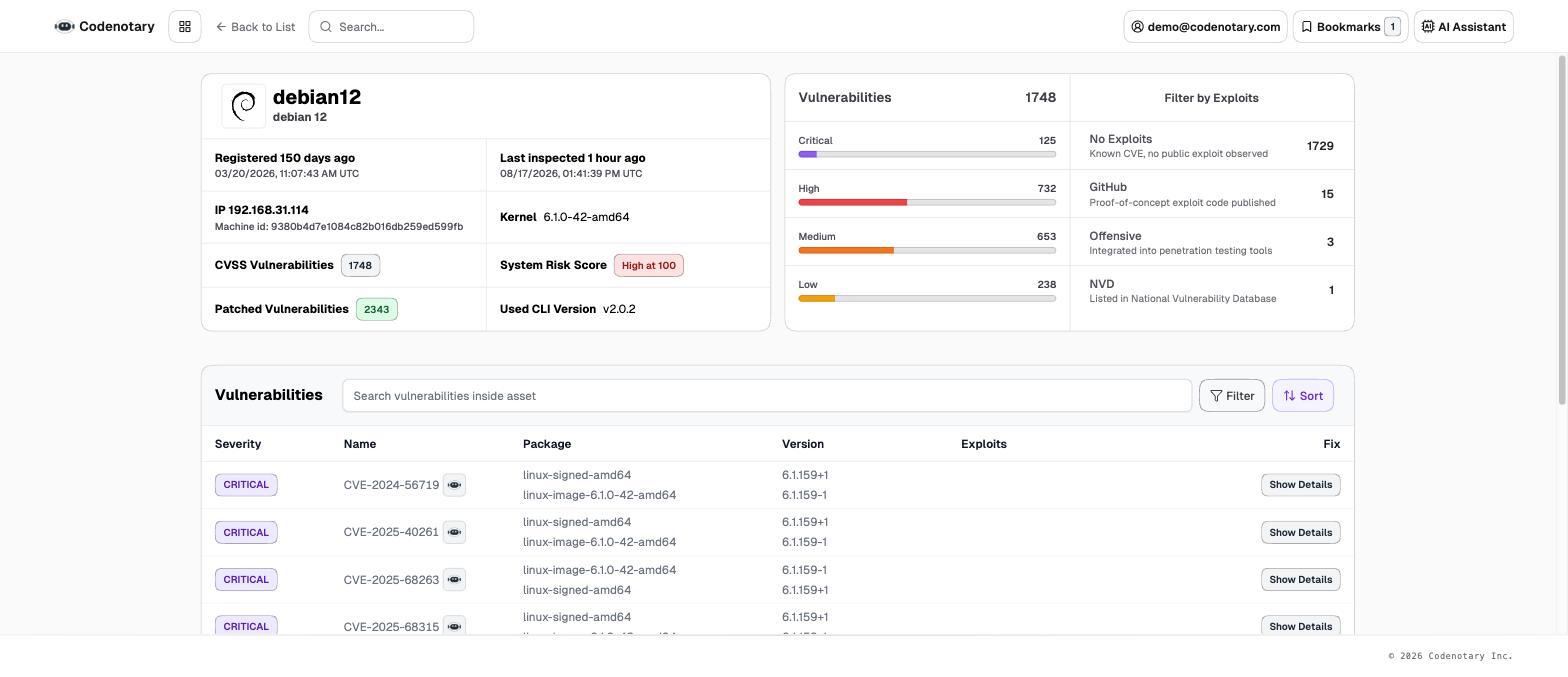
Patch Management. The Filter by Exploits panel turns 1,748 findings into a short list.
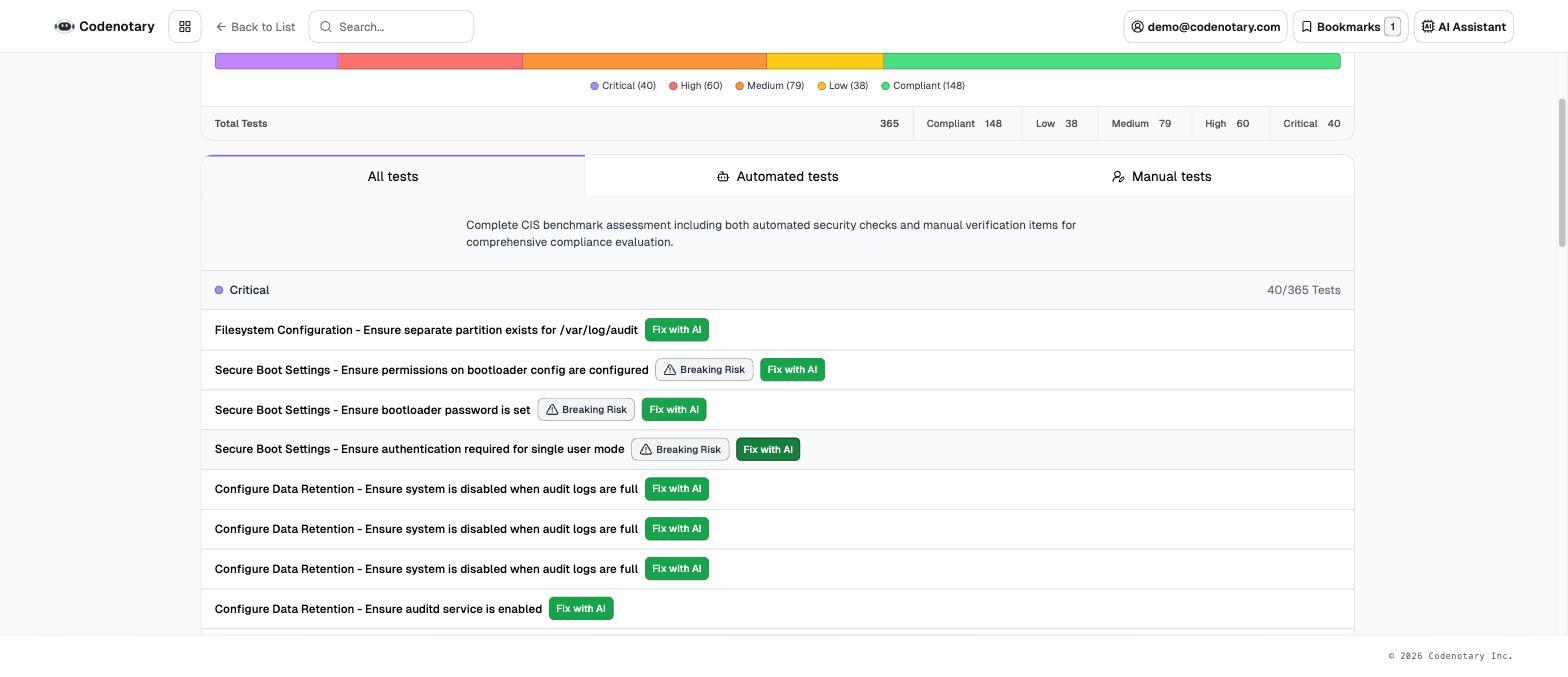
Linux Compliance. Risky controls carry a Breaking Risk tag before you run them.
Three modules. One install.
Turn on what you need. Same agent, same inventory, same reporting.
Autonomous Security
- Live host inventory with agent status
- OS updates applied on approval
- Config improvements enforced continuously
Linux Compliance
- 365 controls per host, Critical through Compliant
- "Fix with AI" on individual controls
- Breaking-risk flags before you apply
Linux Patch Management
- Full CVE inventory, kernel and userspace
- Exploit intelligence: PoC, offensive tooling, NVD
- Exact fixed package version for every CVE
Start free. Pay when it's doing real work.
First five hosts free, permanently. Then pick your modules.
Application Security
- →Vulnerability management and monitoring
- →CIS benchmark compliance
- →PCI compliance
- →Complete API framework with MCP
- →CSV / XLS export
Compliance
- →
PDF reports·CIS benchmark·PCI
- →Complete API framework with MCP
FIPS 140-3 scans
- →
Internal·Data protection·Key management
- →
External·Secure communication·Web application security
- →
Supported technology·WordPress·Shopify
Start free. Pay when it's doing real work.
First five hosts free, permanently. Then pick your modules.
Sign up
Free for five hosts. No card.
Install the CLI
One command per host, or push it with Ansible.
Read your first scan
CVEs, CIS score and config findings, ranked and ready to fix.
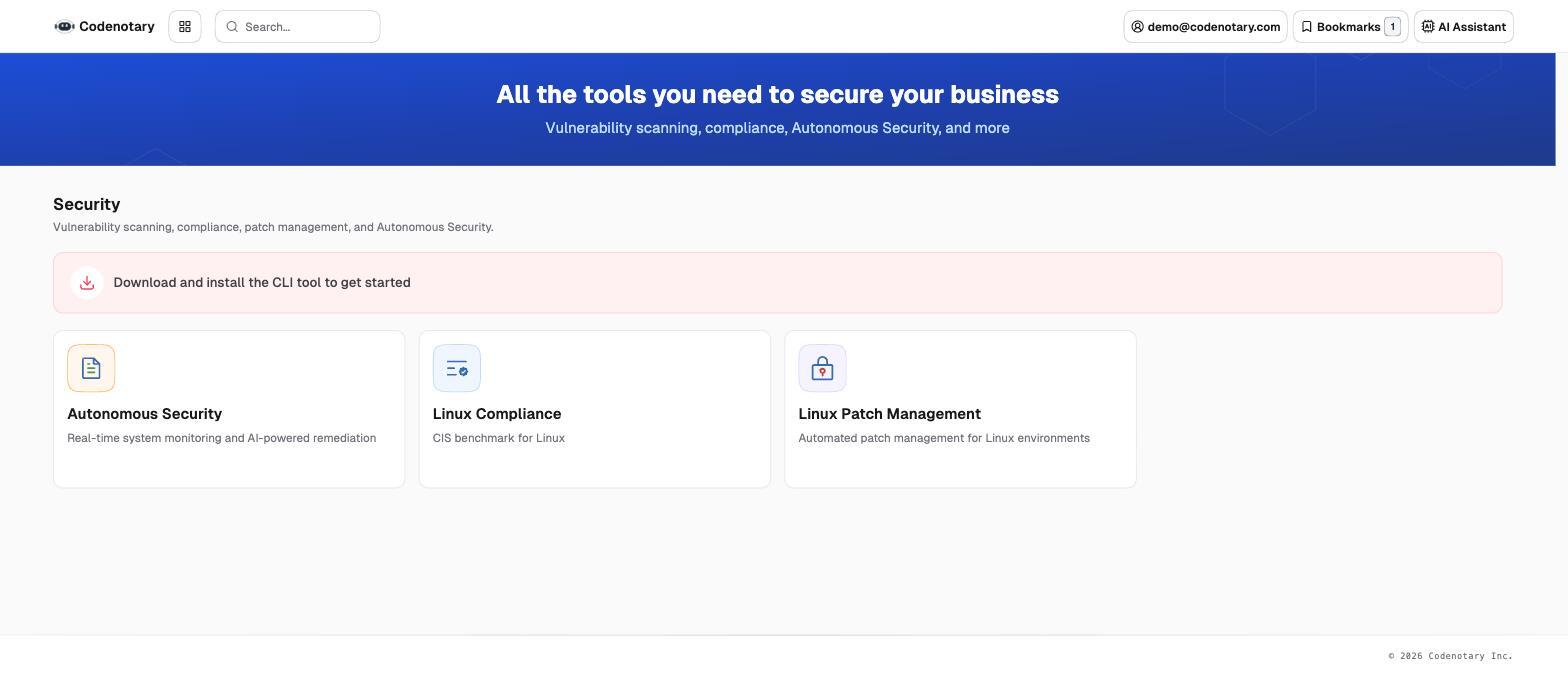
First screen after signup. Install the CLI and the modules light up against your fleet.
Questions sysadmins actually ask
Does it need an agent?+
A single CLI binary per host — no kernel module, no appliance. It scans on schedule and applies fixes only when you approve them.
Will "Fix with AI" break my production servers?+
Risky controls — bootloader passwords, single-user-mode auth — carry a Breaking Risk label. Nothing applies without your explicit action, and every change is logged.
I already have a vulnerability scanner. Why this?+
Most scanners hand you a sorted CVSS list and stop. Trust tells you which have public exploit code, the version that closes each one, then applies it — a resolved ticket, not a report.
Five hosts. Three minutes. No card.
See what's exposed across your estate before deciding it's worth paying for. Protect your first 5 hosts free
Already running Codenotary? Sign in at apps.codenotary.com