Coding agents change where the work piles up. They open changes faster than people can review them, and they run for hours without anyone watching. Keeping teams unblocked and knowing that a long session kept its progress are two sides of the same question: can you scale agent usage without the friction scaling with it? AgentMon Start answers it with two views, team coordination and long-running agents.
Team coordination: the bottlenecks agents create downstream#
An agent that finishes a task in ten minutes has not saved anything if the change then waits four days for review. The cost moves from writing code to reviewing and integrating it, and that cost is spread over people who did not ask for it.
AgentMon Start shows the review and integration load by team and reviewer:
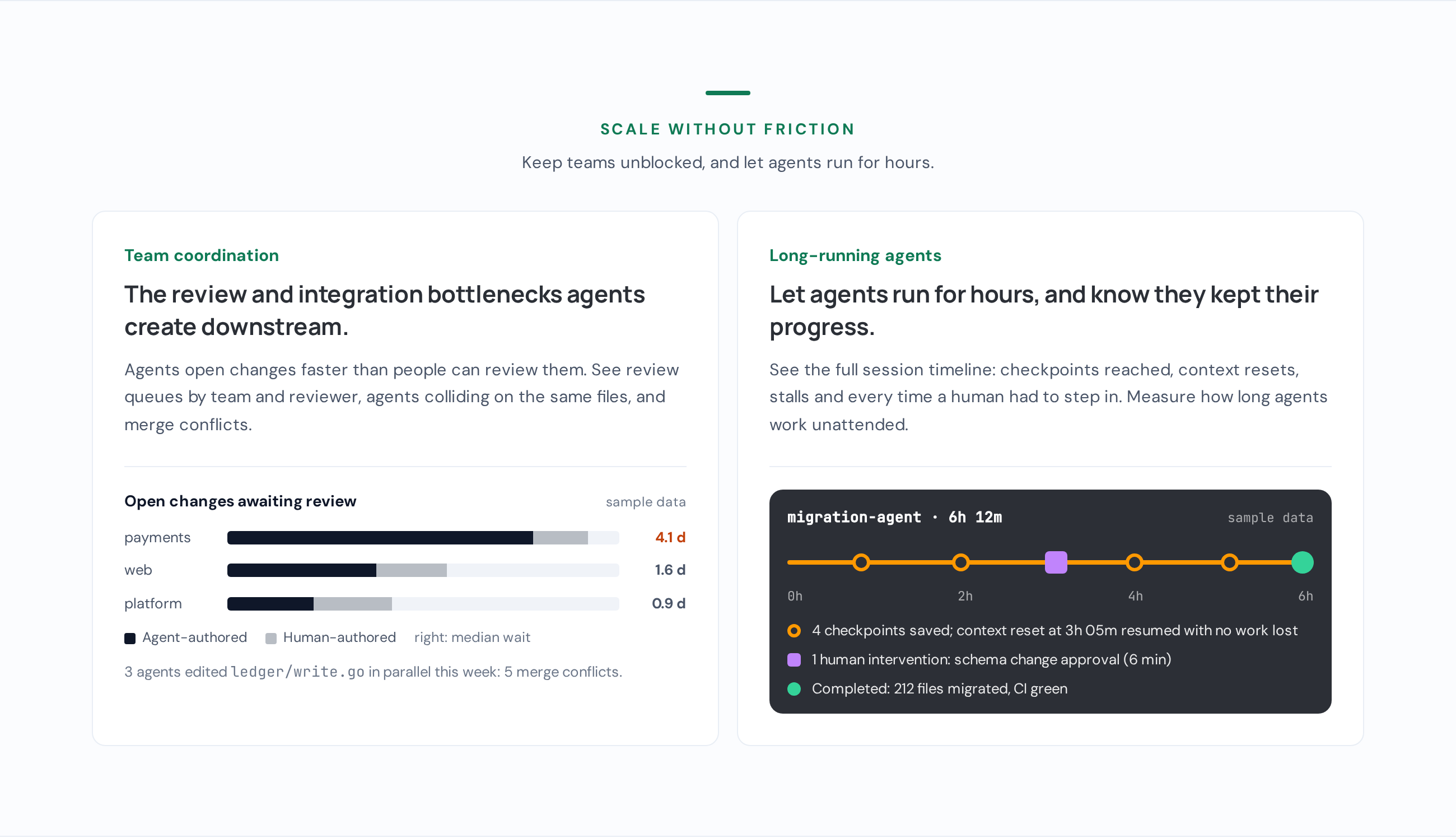
- Review queues: open changes awaiting review per team, split into agent-authored and human-authored, with the median wait on the right. A queue that is mostly agent-authored and growing is a team that needs review capacity or a smaller agent task size, not more agents.
- File collisions: agents working on the same files at the same time, and the merge conflicts that follow.
- Merge conflicts: counted per file and per week, so the hot spots are visible before they become a habit.
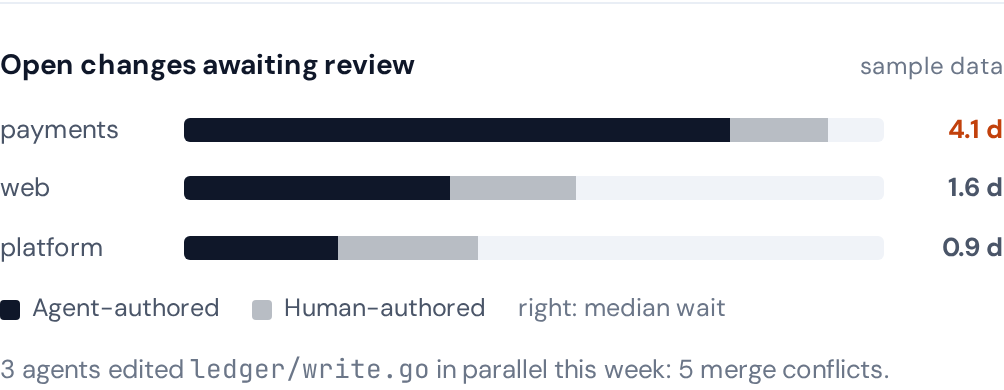
In the sample above, payments has the longest queue, 4.1 days median wait, and almost all of it is agent-authored. The footnote names the second problem: three agents edited ledger/write.go in parallel that week and produced five merge conflicts. Both are fixable once seen, by routing payments reviews differently or by serialising work on the ledger package.
Long-running agents: hours of work, and proof it survived#
Long agent sessions are where the biggest wins and the biggest losses hide. A migration agent that runs for six hours is a bargain if it finishes. It is an expensive way to lose an afternoon if it stalls at hour three, loses its context and starts over without telling anyone.
AgentMon Start records the full session timeline:
- Checkpoints reached, so you know which progress is saved.
- Context resets, and whether the agent resumed from a checkpoint or lost work.
- Stalls, where no progress was made for a stretch of time.
- Human interventions, each time a person had to step in, and for how long.
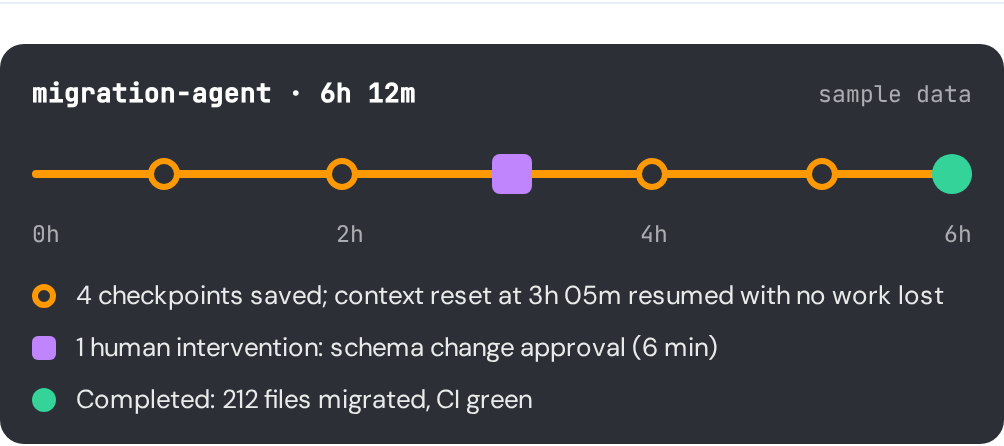
The sample session ran for 6 hours 12 minutes. Four checkpoints were saved. A context reset at 3h 05m resumed with no work lost. One human intervention, a schema change approval, took six minutes. The agent completed with 212 files migrated and CI green. That is the record a team needs before it lets agents run overnight: not a promise that long sessions work, but a timeline of the ones that did and the ones that did not.
The same data feeds a single number on the scorecard, longest unattended run, so the trend is visible without opening a timeline.
Why these two views belong together#
Both measure the same thing: how much human attention each unit of agent work costs. Review queues show attention spent after the agent finishes. Interventions and lost progress show attention spent while it runs. Reduce both and agent usage can grow without the team feeling it.
Every chart in this post is sample data from the product. Your queues, collisions and session timelines come from your own repositories and agents.
Get started#
AgentMon Start is free for 3 seats for 6 months. Connect your agents and both views appear once sessions and review data arrive.