Claude Code, Codex, Kiro or Cursor? Teams rarely run just one coding agent, and each harness is good at different work. AgentMon Start builds a harness comparison report from your own repos and task types, held to the same review standard, and shows the most productive harness for each kind of task.
Why compare harnesses at all#
Every harness benchmark you can download was run on someone else’s code. Your repos, your conventions, your review bar and your mix of tasks are different, and that is what decides whether a harness pays off for you. A harness that writes tests nobody touches can still be the wrong choice for a large migration.
The question is not “which harness is best”. It is “which harness is best for this kind of task, on our code, at what cost”.
What the report measures#
AgentMon Start follows every task an agent takes from start to merge, so the comparison is built on outcomes rather than on opinions:
- Merged as-is: the share of changes that were accepted without a human rewriting them. Lightly edited and substantially rewritten changes count against the harness.
- Cost per merged task: total spend on that task type, including the attempts that never shipped, divided by the tasks that merged.
- Tasks: how many tasks of that type were measured, so a result from a handful of runs is not mistaken for a trend.
Every harness is held to the same review standard, because a comparison means nothing when one agent’s output gets a softer review than another’s.
What a report looks like#
The example below is sample data from the product, not a published benchmark. Your numbers depend on your repos and your reviewers.
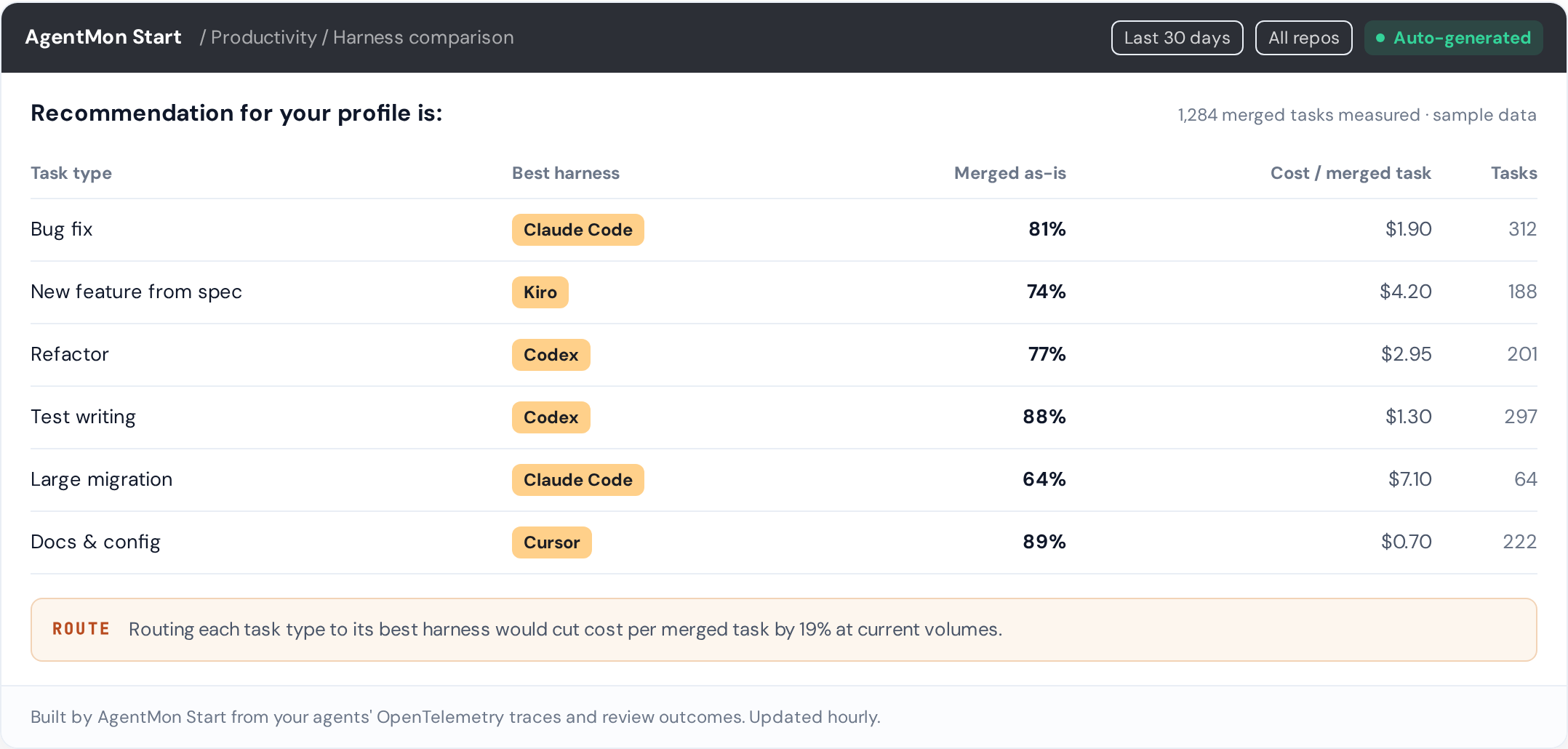
| Task type | Best harness | Merged as-is | Cost per merged task | Tasks |
|---|---|---|---|---|
| Bug fix | Claude Code | 81% | $1.90 | 312 |
| New feature from spec | Kiro | 74% | $4.20 | 188 |
| Refactor | Codex | 77% | $2.95 | 201 |
| Test writing | Codex | 88% | $1.30 | 297 |
| Large migration | Claude Code | 64% | $7.10 | 64 |
| Docs and config | Cursor | 89% | $0.70 | 222 |
Three things stand out in a report like this:
- No single winner. Four harnesses share six task types. A team standardising on one harness would be paying more, or reworking more, on at least half of its work.
- Cost and quality do not move together. Large migrations have the lowest merged-as-is rate and the highest cost per merged task. That is where review time and budget go, and where a change of harness or of task size matters most.
- Routing is worth real money. In this example, sending each task type to its best harness would cut cost per merged task by 19% at current volumes. The report states that figure so the decision can be made with numbers, not anecdotes.
How the report is built#
AgentMon Start collects your agents’ OpenTelemetry traces (sessions, tool calls, tokens and cost) and joins them with review outcomes from your repositories: what merged, what was edited, what was rewritten. Task types come from the work itself, not from manual tagging. The report updates hourly and can be filtered by time range and by repo.
Conversations and prompts stay on the developer’s machine. The comparison needs outcomes and cost, not the content of the work.
Get your own comparison#
AgentMon Start is free for 3 seats for 6 months. Connect your agents and the harness comparison appears under Productivity once enough merged tasks have been measured.