This week was about who gets to use coding agents and what those agents send out. Goldman Sachs narrowed access, a user reported an email address in a Claude Code request header, and a small open model posted a top score on a coding benchmark.
The chart#
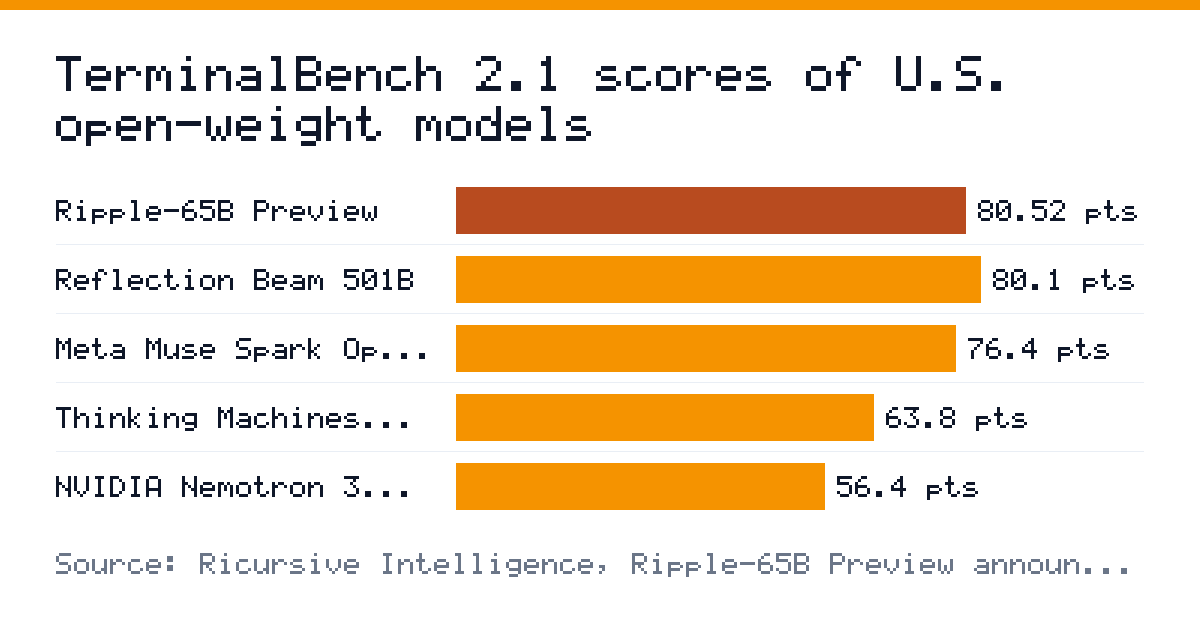
TerminalBench 2.1 scores of U.S. open-weight models#
Ripple-65B has the fewest parameters in the chart and the highest score. The 975B model scores 63.8. The 550B model scores 56.4. Size in the name does not predict the result. The scores come from Ricursive’s own announcement, so test the model on your own tasks.
This week#
User says Claude Code put their email into web request headers#
A user filed a bug report in Anthropic’s Claude Code repository on GitHub. They say the agent put their email address into the User-Agent header during web searches. They report dozens of scam emails a day since. The issue is open and tagged as a security bug on macOS, version 2.1.318. Teams should audit outbound request headers. github.com
Goldman Sachs limits coding agents to its engineers#
Goldman Sachs updated its internal guidance in October. Claude Code and Microsoft’s GitHub are limited to engineers, Bloomberg News reported, after a review of productivity and risk concerns. Strats, who work across trading, research and engineering, keep access. Traders had used the tools to follow client flows and model market moves. Hong Kong bankers were barred from Claude in April. thestateofai.com
Ripple-65B Preview posts a top open-weight score on TerminalBench#
Ricursive Intelligence released Ripple-65B Preview, an open-weight model with 65B parameters and a 1M token context window. It was pretrained on 12 trillion tokens. The lab reports 80.52 on TerminalBench 2.1, ahead of Reflection Beam 501B at 80.1. The size is small enough for local hardware such as NVIDIA DGX Spark. Test it on your own repos before trusting benchmarks. ricursive.com
Recalc turns spreadsheet cells into Claude Code and Codex terminals#
A developer built Recalc, a spreadsheet where each cell can be a Claude Code or Codex terminal session. A lead session sits in a side panel. Cells message each other through grid references, named cells or an MCP server. The author uses it for evals and benchmarks. It runs locally on macs. Linux is less tested and Windows is untested. github.com
From our blog#
Innovation Should Not Require Permission#
Game Developer reported on October 30 that Anthropic changed the instructions for Claude Code running on Opus 5.5. The new rule discourages recreating specific existing games, even when the copy is renamed or described as original. Anthropic says original games, genre games and projects built on a developer’s own designs and assets should still work. It invites developers to report refusals.
Moshe, who wrote the post, says the trouble is missing context. A studio may commission a remake. A rights holder may hire a team to port an older title. A developer may rebuild their own game after losing the source code. The prompt alone cannot show who owns what. A rule built on whether the game exists can treat that gap as a reason to refuse. The post accepts that cheap copies hurt game makers. It adds that renaming a copy does not fix infringement and naming an existing game does not prove it.
The same question reaches past games, since teams replace old systems and build compatible interfaces all the time. The post asks for a clear route for authorized work. A developer should be able to state a license or permission and have it considered.
AgentMon Start reads the session logs that agents like Claude Code and Codex already write, so you can see on your own machine what each agent costs, which tools it ran and what it touched.
P.S. The Recalc author built a small FDA Bench with the tool. It collects dossiers of FDA submissions and checks whether a harnessed Claude could have predicted pass or fail. github.com